Back on the Ice (or Field) After a Concussion: Your Step-by-Step Return-to-Sport Roadmap

Have you ever watched an athlete take a hard hit, sit up slowly, and hear someone shout, “Shake it off”?
It is an instinctive reaction. Sport rewards toughness. Keep moving. Get back in the play.
But when it comes to a possible concussion, “shake it off” is outdated advice. A concussion is a brain injury. The athlete should come off the ice, field, or trail and be assessed: not sent back in to prove how tough they are.
As fall sports ramp up across Port Alberni, that matters for hockey players, soccer players, cross-country runners, parents, coaches, and teammates. The goal is not to keep an athlete out forever.
The goal is to get them back safely: and confidently.
What actually happens during a concussion?
A concussion is a mild traumatic brain injury caused by a forceful hit, jolt, or rapid acceleration and deceleration of the head or body.
It is not a bruise you can point to, or a torn muscle with a clearly damaged structure. Instead, a concussion creates a temporary disruption in how the brain functions. It is an energy crisis in the brain, not a "brain bruise."
During the impact there is stretching and shearing of neurones within the brain. This changes the natural ion balance within them causing an excitatory response and the neurones begin to fire; like an electrical storm within the brain. To restore balance, brain cells need to work harder than usual while creating a demand for energy, but its capacity to produce that energy is damaged; this leads to an energy crisis within the brain. It is a bit like asking your phone to run five demanding apps while the battery is stuck at 12%.
The phone may still turn on. But everything becomes slower, glitchier, and less reliable.
That can lead to symptoms such as:
- Headache or pressure in the head
- Feeling foggy, slowed down, or confused
- Fatigue or unusual sleepiness
- Dizziness or balance problems
- Nausea
- Sensitivity to light or noise
- Blurred vision
- Difficulty concentrating or remembering
- Neck pain
- Irritability or emotional changes
A concussion does not require loss of consciousness. In fact, many athletes stay awake and continue talking after an injury while still having a concussion.
So, no dramatic movie-style blackout is required. The brain can be shaken up without switching completely off.
First things first: remove the athlete from play
If a concussion is suspected, the athlete should be removed from sport immediately.
No same-day return.
No “let’s see how they feel after a few minutes.”
No sneaking back onto the field because the team is short a player. We know how tempting that can be. But the brain is not a spare set of shin pads.
The athlete should be assessed by a qualified healthcare professional. In the meantime, avoid activities with a risk of another head impact, including hockey, soccer, biking, skiing, and contact drills.
If symptoms are worsening or severe, seek urgent medical care.
Concussion red flags: go to the ER
Call 911 or go to the emergency department immediately if the athlete develops:
- A headache that is worsening and does not go away
- Repeated vomiting
- Slurred speech
- Weakness, numbness, or decreased coordination
- A seizure or convulsion
- Increasing confusion, agitation, or unusual behaviour
- Difficulty waking up or staying awake
- Loss of consciousness
- Trouble recognizing people or places
- Visible deformity of the skull
These signs can indicate a more serious brain injury. Do not wait to see if they settle down.
Is total rest in a dark room still recommended?
For years, concussion advice often sounded like this: lie in a dark room, avoid screens, avoid exercise, avoid school, avoid life.
The problem? Complete isolation and total rest can sometimes make recovery harder.
The modern approach is relative rest for roughly 24–48 hours, followed by a gradual return to daily activity and carefully prescribed exercise. That means reducing activities that significantly aggravate symptoms: but not necessarily stopping every normal activity.
Gentle walking may be appropriate. Brief periods of schoolwork may be appropriate. The right dose depends on the person and their symptoms.
And here is the exciting part: early, symptom-limited movement can help the recovery process. It is not about “pushing through.” It is about giving the brain and body small, manageable challenges.
Think of it like turning a dimmer switch back up: not flicking the lights on at full brightness.
Timelines for recovery, and why returning too soon is risky
Usually, concussion symptoms settle within 7 to 15 days. That is what we mean by clinical recovery.
But here is the catch: feeling better is not the same as being fully recovered. While your symptoms are fading, your brain is still doing repair work behind the scenes. Full physiological recovery can take around 30 days. Only once the brain's energy levels have been restored can you confidently return to play without any lasting impairment.
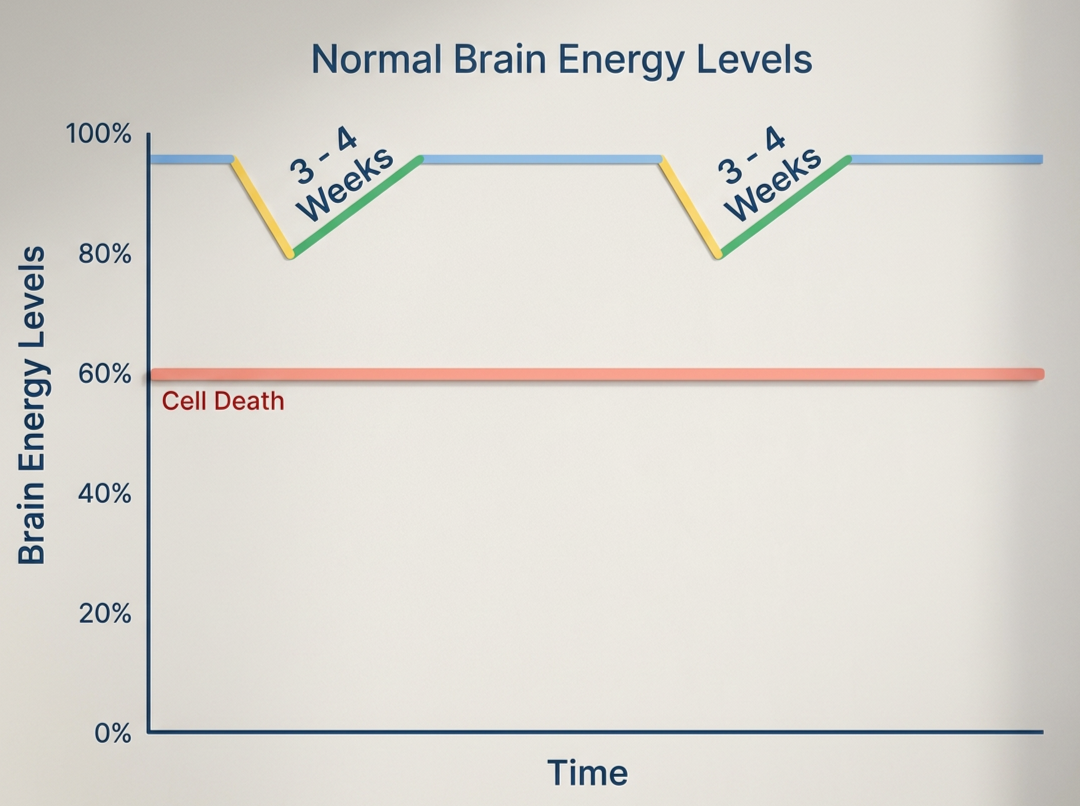
After a concussion, there is a ~20% drop in energy within the brain.
It takes only about 7-15 days for the symptoms of a concussion to subside. But it can take up to 30 days for the energy deficit to be restored.
That gap, between your symptoms settling and your brain fully recovering, is what we call the window of vulnerability.
Return to play, or take a second impact, inside that window, and the consequences can be serious: a significantly prolonged recovery, or in rare cases what we call Second Impact Syndrome, where full recovery may not happen at all.
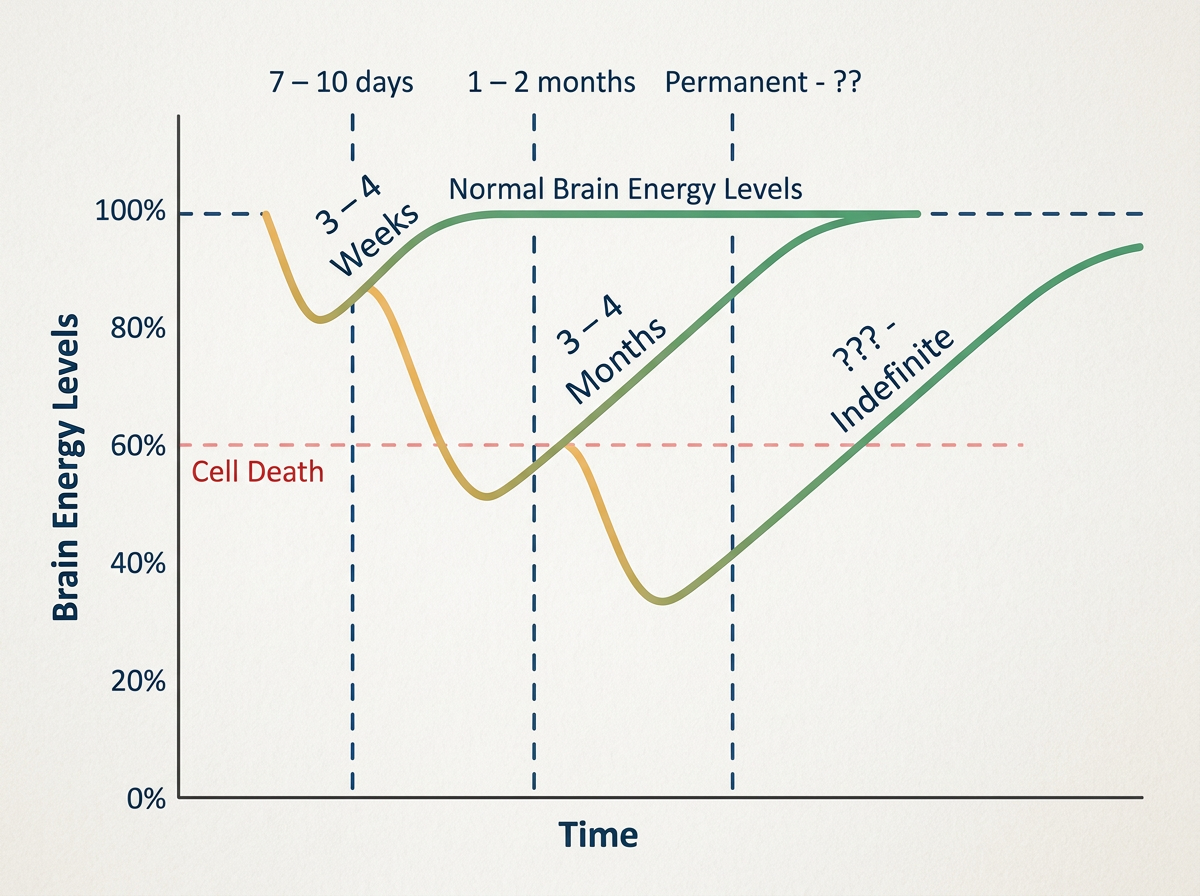
A second concussive event before full physiological recovery can significantly prolong recovery times.
In some cases, the brain may never fully recover.
It is a sobering thought. And it is exactly why we do not rush this process.
The six-step return-to-sport roadmap
The current return-to-sport process is gradual and symptom-guided. Each step usually takes a minimum of 24 hours. An athlete should only move forward if symptoms remain stable.
If symptoms significantly increase, stop, allow them to settle, and return to the previous step.
Step 1: Symptom-limited Cognitive and Physical activity
This begins immediately following a concussion and lasts a maximum of 2-3 days. The general advice is to take it easy for a day or two, but don't just lie in bed all day.
The athlete can gradually resume normal daily activities such as:
- Light walking
- Short periods of reading or screen use
- Schoolwork with appropriate breaks
- Simple household activities
The aim is to reintroduce normal life without significantly increasing symptoms.
For student athletes, returning to school is important. In many cases, an athlete should be back to regular learning before returning to sports with a risk of collision or falling.
You should try to see a concussion-trained physiotherapist as soon as possible following a concussion. Early intervention has been shown to improve outcomes following a concussion.
Step 2: Light aerobic exercise or cognitive activity
This may include:
- Easy walking
- Gentle stationary cycling
- Homework/working from home, answering emails etc. up to 1 hour at a time.
Exercise should be controlled and symptom-limited. Over time, the athlete can progress toward moderate aerobic exercise: approximately up to 70% of maximum heart rate: under the direction of a healthcare professional.
A concussion-trained professional will put you through the Buffalo Concussion Treadmill Test (BCTT) to determine the optimum heart-rate threshold you should be training at to maximise the benefits of this stage.
The athlete should not be sprinting, lifting heavily, or exercising in a way that creates a risk of another head impact.
A small, brief increase in symptoms may be acceptable in some rehabilitation plans. A large increase, or symptoms that linger afterward, means the intensity was too high.
Step 3: Sport-specific exercise without head impact or contact, Half days at work/school with restrictions
Once the athlete has successfully completed the BCTT, we start making the activity look more like the sport.
For example:
- A hockey player may skate and handle the puck without contact
- A soccer player may jog, pass, and shoot without heading or challenging for the ball
- A cross-country runner may gradually increase running duration and terrain demands
There should be no body checking, heading, tackling, scrimmaging, or drills with a meaningful risk of falling or collision.
Step 4: Non-contact training drills, Full days of work/school with restrictions
This step brings the athlete closer to regular practice. A Chicago Blackhawks test may need to be passed for high-risk/contact athletes.
They may participate in:
- More complex sport-specific drills
- Higher-intensity running or skating
- Progressive resistance training
- Team warmups
- Non-contact tactical work
The athlete is training, but still not participating in contact or collision.
Before moving to full-contact practice, medical clearance is required. Depending on the athlete’s age, sport, and healthcare pathway.
Step 5: Full-contact practice
Only after medical clearance should the athlete return to full-contact practice.
This allows them to test:
- Contact tolerance
- Confidence
- Reaction time
- Position-specific skills
- Fatigue management
- The ability to respond to fast, unpredictable play
A full practice is not exactly the same as a game. It is a useful bridge.
Step 6: Full return to game play
This is the final step: returning to competition at the athlete’s normal level.
The athlete should be symptom-free or back to their pre-injury baseline, have completed the previous steps successfully, and have received the required medical clearance.
A conservative planning benchmark is roughly 21 days or more from the injury before full competitive return, particularly for contact and collision sports. Treat that as a minimum, not a target. Remember the timeline above: symptoms often settle within 7 to 15 days, while physiological recovery can take around 30, so neither the calendar nor one good day on the ice should be the green light on its own. Children and teenagers may need longer still. The exact timeline depends on symptoms, age, sport, previous concussions, school participation, and medical guidance.
The calendar matters. But the athlete’s recovery matters more.
Where physiotherapy fits
Most athletes recover well. However, up to approximately 30% of people can experience symptoms that linger.
That is where concussion-focused physiotherapy can help.
The tricky thing is that not every symptom comes directly from the brain. The same impact that causes a concussion can also create a whiplash-type injury to the neck. The inner-ear balance system, visual system, and cardiovascular system can also be affected.
So the question becomes: is the headache coming from the brain, the neck, the vestibular system, or a combination?
Your physiotherapist acts a bit like a symptom detective: minus the trench coat and dramatic detective music.
An assessment may look at:
- Neck movement, strength, and coordination
- Headaches and neck pain
- Dizziness and balance
- Eye tracking and gaze stability
- Motion sensitivity
- Exercise tolerance
- Reaction to changes in heart rate
- Sport-specific movement demands
Treatment may include:
- Cervical manual therapy
- Neck and upper-body strengthening
- Vestibular exercises
- Balance and gaze-stability exercises
- Graded aerobic exercise
- Education and pacing
- A structured return-to-learn and return-to-sport plan

The goal is not simply to ask, “Do you still have a headache?”
It is to understand what is driving the symptoms and gradually rebuild tolerance to the activities that matter.
Concussion care in Port Alberni
At Innov8 Physiotherapy, we are proud to be a Complete Concussions Certified Clinic.
Our Complete Concussions program includes:
- Pre-season baseline testing
- Post-concussion assessment and rehabilitation
- Return-to-learn, work, and play support
- Exercise rehabilitation
- Vestibular and balance rehabilitation
- Neck-focused treatment
- Symptom tracking and progression planning
Our team at Innov8 Physiotherapy are highly trained and experienced in the world of concussion to facilitate your successful recovery from a concussion. Having a baseline test performed prior to a concussion can be extremely useful in guiding return-to-play decisions after a concussion. We are happy to work with individuals or teams to perform pre-season baseline testing.
We understand that athletes want to get back to their team. Parents want a clear plan. Coaches want to know when participation is safe.
Most importantly, we want to help athletes return to the activities they love without rushing the process.

The bottom line
A concussion is not something to “shake off.”
It is a mild traumatic brain injury that deserves proper assessment, monitoring, and rehabilitation. Total rest in a dark room is no longer the whole answer. Gentle early activity, followed by a structured six-step progression, is the modern approach.
Remember:
- Remove the athlete from play.
- Watch for red flags.
- Begin relative rest, not complete isolation.
- Progress through the six steps gradually.
- Take at least 24 hours per step.
- Drop back if symptoms spike.
- Get medical clearance before contact and competition.
- Respect the window of vulnerability: feeling better is not the same as being recovered.
- Expect the process to take time: especially for younger athletes.
If you or your young athlete has sustained a concussion, or symptoms are not settling as expected, book an assessment with Innov8 Physiotherapy in Port Alberni.
Let’s build a safe, practical roadmap back to the ice, field, trail: or whatever gets you moving.
Helpful resources
- Innov8 Physiotherapy Complete Concussions Program
- Innov8 Physiotherapy Services
- Innov8 Physiotherapy online booking
- 2023 Amsterdam International Consensus Statement on Concussion in Sport
- Canadian Guideline on Concussion in Sport, 2nd Edition
- CDC concussion danger signs
This article is for general education and does not replace an in-person medical assessment. If an athlete has concussion red flags or rapidly worsening symptoms, seek emergency care immediately.